Friday, February 27, 2015

LEONARD NIMOY IS GONE. "REMEMBER".

Like thousands of Star Trek fans around the world, I feel as though I lost a friend today. Leonard Nimoy has died at the age of 83. Unlike his counterpart, we all knew that Mr. Nimoy was all too human and would some day journey to that undiscovered country to which all must go. But it's far too soon for me.

Almost a half-century ago, as a very young boy I discovered Star Trek. I had no idea that it would change my life, of course. But even then, with all the bright colors, phaser blasts and the fighting captain, Spock was the character that grabbed my attention from the start. He was alien and smart and.. well... cool. In every way. More than any other character, Spock would define what, exactly, Star Trek was – and is.

All Trek fans know what Mr. Nimoy brought to Star Trek so I won't waste your time with that. But suffice to say that this Trek fan is grieved more than I thought I could ever be about the loss of someone that I have never met. Mr.  Nimoy's innate intelligence and grace will be missed by this life-long fan more than I can say.


As Dr. McCoy said about Spock at the end of "Wrath of Khan", "he's not really dead – as long as we remember him."

And we will remember. And feel grateful that we got to experience the fruits of this man's art. We'll always know that he truly did live long and prosper.

And we're the better for it. Here's his last Tweet:
Amen, my Vulcan brother. Thanks for a lifetime of fun, Mr. Nimoy.

Don

Thursday, February 5, 2015

SHIELDS UP! ANOTHER HORRORDOMAIN AUCTION, ANOTHER ROUND OF BULL

There's another auction on-line from HorrorDomain. And the horror is the crap that they are offering. To wit:

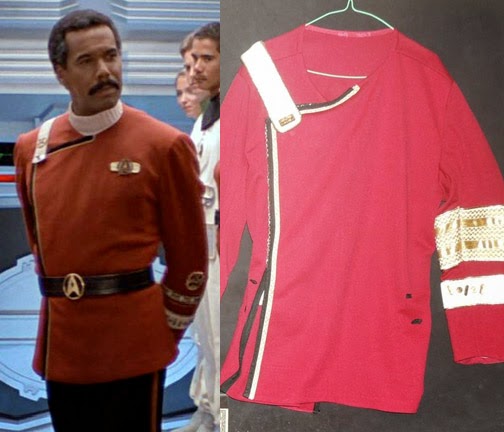
"STAR TREK 3 THE SEARCH FOR SPOCK ADMIRAL UNIFORM WITH RANK PINS RARE MAROON VERSION"

Let's be clear, This is NOT and never has been a production-made maroon uniform, not for Star Trek 3 or any other production. What it probably is is a uniform made for "The Star Trek Adventure" at Universal Studios in LA that ran in the 80's/90's. The Star Trek Adventure had various costumes – Maroons, Radiation Suits, etc – for the participants to wear as they re-enacted a scene from Wrath of Khan. The "Paramount" label is probably real since the Paramount costume department apparently furnished the pieces that were used by various park employees and participants. But that does NOT make it production-made in the film sense. The label says AO-3, which probably means it is "uniform #3", as it was definitely NOT made for Star Trek 3!

Below is a real Star Trek 3 Admiral shown with the HorrorDomain offering. The band on the sleeve is particularly bad-looking and the material is obviously not the same. It is identified as a "background admiral's uniform". This despite the fact that background maroon jackets looked EXACTLY LIKE main cast maroons. They didn't dumb them down, especially in such an obvious way.


 Here's a shot from The Star Trek Adventure that shows their maroon uniforms. Note that they are overall sloppy because they had to be able to be worn by tons of people. And no, DeForest Kelley wasn't actually there!


The other silly Trek piece is the "Uhura Wig" signed by Uhura herself, Nichelle Nichols! The likelihood of this being real are so astronomical that I won't even waste time with that. Suffice to say that, other than a Nichelle Nichols autograph on a wig stand, there is ZERO proof offered that this piece was actually used in Star Trek. It definitely could NOT have been used in the pilot episode as Miss Nichols didn't even appear in it!


Keep in mind that the autograph could be real but has nothing to do with authenticity of the wig. It could have gone like this: picture someone at a Trek con coming up to Miss Nichols with this item saying, "Hey, Nichelle, look what I have – a wig that looks just like the one you wore! Could you sign the stand for me, please?" And, voila – we have an authentic wig! To be truly authentic, this would have to have impeccable provenance – a chain of ownership that could be proven to go back to the studio. This offers nothing but an autograph.

As for the "Saavik robes" that style was originally made for The Motion Picture and they made a TON of them! There's no label that says "Kirstie Alley" or "Saavik" or anything like that. So, while the style is similar, there's NO PROOF OFFERED of authenticity. Same for the attribution of the TNG teal uniform to Gates McFadden/Dr. Crusher. There were plenty of teal uniforms that were worn by other actors. Just because it's teal doesn't make it hers.

HorrorDomain's past auctions had crap like this going on as well. Don't be fooled.

LLAP

Don

Sunday, January 11, 2015

BANKRUPT PROPWORX RETURNS FROM THE DEAD? THERE'S A SUCKER BORN EVERY MINUTE.

How does The Wizard of Oz put it? "Pay no attention to that man behind the curtain!" Apparently that's what Alec Peters, president of Propworx, is hoping his consignors do. Though, "pay no attention to that bankruptcy in my past!" is more like it.

Mr. Peters' former company, Propworx, a movie prop and costume reseller, went bankrupt under his leadership back in 2012, leaving behind a debt in excess of $400,000. Many of his detractors (like me) said "good riddance". His creditors had their own words for him, I'm sure. On a side note, along with Propworx, Mr. Peters also brought us The Prop Blog, written by his pal and former employee Dan Benton. Fong Sam, head of Blacksparrow Auctions, called The Prop Blog "the most antagonistic, divisive and disingenuous prop blog extant" when it shut down. Fong's headline for that event was "Good Riddance".

Are you sensing a theme?

So with Propworx securely and rightfully snug in its well-deserved grave, imagine my surprise when I heard rumors of a new Propworx auction coming down the pike. Was Propworx being re-born as a new company? Or was the name simply being used by Mr. Peters as a DBA ("Doing Business As")? Beats the hell out of me. Whatever the details, Mr. Peters has recently announced a new Propworx Star Trek auction with a catalog and everything.

Which begs the question: who would consign their valuable props and costumes to a company that went bankrupt just two years ago? After all, the last time someone trusted Propworx (like MGM with their Stargate materials) they got burned. Really bad. Like hundreds of thousands of dollars bad. Keep in mind that, when things went south, Mr. Peters could have tried to keep things going and attempt to pay back his creditors by filing for Chapter 13 bankruptcy – what is commonly called "restructuring". But instead, he went directly for Chapter 7 – liquidation. Nobody got paid. No one, that is, except for Mr. Peters, of course. Apparently, bankruptcy's not as bad as it's made out to be as long as you're on the right side of said bankruptcy.

Again, why would anyone put their property in the hands of someone who ran his company into the crapper? I have to assume that those involved are either not well-versed in Mr. Peters' past, or, if they are, they don't care. But given the $400,000+ debt that Mr. Peters walked away from in 2012, who wouldn't care? It boggles the mind. The headline says it all.

So, will Mr. Peters be afflicted with bankruptcy yet again, to the chagrin of his consignors? Or will he find a way to more responsibly manage the funds at his disposal than he has in the past? Is he suddenly a better business man? For the sake of his consignors, I certainly hope so.

Only time will tell.

LLAP

Don

Thursday, December 11, 2014

"THE CAGE" LASER ON AUCTION AT JULIEN'S PART 3: THE OUTCOME

If you're someone who was watching the Julien's auction of the Cage Laser, you know by now that the piece was pulled from the auction. Here's the rest of the story as to how it got to auction and why it was pulled. FYI: I was recently caught up in the home-buying experience which took my total attention away from this topic. Sorry for the delay.

Also, much of what has come to be known is a result of a discussion that I initiated on The Trek Prop Zone, a forum of passionate Star Trek prop fans. Members include contributors to HeroComm.com, one of the most respected clearinghouses of Star Trek TOS prop information in the known universe! It was that discussion that yielded the inevitable truth regarding The Cage Laser at Julien's. All photos of the Jein Laser have come from various gray sources and I hope my use here is acceptable. If you are the owner of any image used here and object to the use, please contact me.

So why was the Laser believed to be real? One of the most important things to me was the person who was selling it. While I'm not free to share that person's identity, suffice to say that they have had a great track record in the past with such pieces. The owner believed that it had a line of ownership that took it back to the studio. But that belief could not be proven. So the piece had to stand on its own merits.

So what's right with the piece? A lot! Let's start with a basic comparison. Here's a side-by-side comparison of the only known Laser – the Greg Jein version mentioned in Part 1 – on the left (note that the Jein version shows the opposite side from the auction version – we have to use what we are given):


The most obvious issue to me was the fact that the auction piece seemed way too clean, especially when compared to the Jein which shows tons of wear. But that alone couldn't disqualify the piece. After all, it could have gone from the set to a box in a closet for fifty years and so wouldn't show the same wear as would a prop that might have been used as a child's toy. So what about the components? The proportions and sizes are an excellent match. Not perfect, but good when we take into account that these things were not mass-produced but individually created. Some parts were probably "found" items (like the barrel) while others were definitely made specifically for the props (the black body). I concluded that the only way this could be a fake was if the maker had access to an original for reference, and what are the odds of that? The size and details shown could not have been achieved from simply using screen captures from the original film. The piece never gets shown cleanly enough to get this close. I deemed it a physical impossibility. More on this later.

What about the triggers? The Jein trigger is a functioning, moveable trigger that was used to activate a battery-powered light for the tip. Since not all props would necessarily have had that feature, the difference doesn't tell us much. The white button doesn't tell us anything either, since that detail was added later (after production of The Cage wrapped) and we don't know if all the Lasers were modified in the same way.

The black raised detail on the top of the body isn't a perfect match in length. But again, so close that any difference could be explained by simply sanding one a bit more than the other. Hand-made pieces, remember.

The most significant difference, though is the grip detail. On the Jein, the detail is cross-hatched, while on the auction piece it is strictly a linear detail. But that's not a deal-breaker if you look at this shot from The Cage:

Grip detail from The Cage
Note that the grip clearly shows a linear pattern like the auction piece, not a cross-hatch like the Jein. Because of this, it's long been held that the original Lasers had a linear pattern on the grip that was then changed to a cross-hatch detail for later uses. After all, it's clearly linear in the screen-caps, right? What else could explain the difference?

So what about the barrel? That's where things get really interesting, IMO. Here's a side-by-side comparison of the two barrels:

Note that the two end rings are a perfect match in size and texture. The center, moveable ring is slightly larger on the auction piece, but, again, well within the tolerances of a hand-made prop that might have used parts cut to size for use. Slight variances would not have been an issue. The makers simply would not have cared. But the bottom line is that the center ring is another detail that does not specifically match the Jein.

Let's move on to the emitter end itself – the business end of the pistol. Here's the two examples:

The Jein is on the left. The black paint was added for later use while the original Cage use had clear acrylic rod (known from screen caps). And when we superimpose the black ends of the Jein over the auction piece, we see that the rod sizes are an absolute match. Not "kind of", but exact. Note that I did not individually resize the Jein details. All three were sized as a single image and placed over the Jein for reference.


Again, this confirmed my belief that the only way this could be a fake is if they had a real piece for reference. And the only known real piece was the Jein which had been in the possession of a TOS production person prior to Jein's ownership, and the piece had never been made public as far as anyone knew. And if this were made specifically from the Jein, all the details should match EXACTLY. And yet they don't. So how could this be a fake? It seemed to me that it was possible that multiple people made the props and variances were introduced because no one executed anything in exactly the same way as the other guys.

But there's one huge element that I thought would be conclusive. The original Lasers were made of Perspex, a very unusual material. It was basically clear plastic which then yellowed over time. Here's what the Jein Perspex looks like now when the metal barrel is removed:


I reasoned that if the Julien's auction piece could be shown to be made of yellowed Perspex, it would be a definitive element since no one really knew what the lasers were really made of all those years ago until the Jein (and the Chopped version mentioned in earlier Parts) came out in to the light of day. How could a faker know that fact decades before it was established as fact?

And so I asked that the barrel be removed so that the material could be established. And this is where things went south. I was told that the barrel was too tight and couldn't be removed. They weren't crazy about drilling a sample, either (though that's exactly what I did with my TOS Klingon Disruptor). So what I considered to be the single most important piece of information was not to be made available. So I gave them my opinion: that while I could not state that the piece was real (I don't have that right with ANY TOS piece), I felt that the only way it could be a fake was if an original was used for reference, and how could that be?

At this point, I want to mention a rather important thing. I was not allowed to talk to anyone about the Julien's auction piece, except in vague, general terms. I was not allowed to tell anyone about it nor share any photos. a situation that greatly hampered the free flow of information. Had I been given the freedom to start a discussion with others, this whole business could have been avoided. It was only by crowdsourcing that the true nature of things could be realized. And it is something that I will insist upon in the future, should the occasion arise.

So once the piece hit the public through the auction catalog, the shit hit the fan, big time.

Of course I was prepared for that. After all, it's a steep hill when you are trying to prove whether a TOS prop is real or not, especially in this case since so little is known about these Laser props. Until now, no one had really made a study of them beyond showing the Jein photos. And, like everyone out there, I knew the unlikeliness of any piece being real. There's so many examples of TOS fakes out there that one would have to be a fool to not know there would be controversy.

But that doesn't mean that all the criticism should be taken at face value. For instance, I was told in no uncertain terms that the piece was a replica that had been made by a specific, known prop maker. But when I checked that out it was obviously not the case, despite the casual insistence that it was. I mention this because, while many people are quick to say "fake", it is only by defining EXACTLY WHY it's a fake that we can know the truth. We need to delve into the true nature of the piece in a very specific, very detailed examination. Only then are we be able to separate the facts from the supposition.

To that end, Trek Prop Zone member and friend of the Blog Will Smith (no relation) brought the first of the unexplainable discrepancies to our attention. He pointed out that even if the grip detail started out as linear but then became cross-hatched, if the bodies came from the same molds (and everyone agrees that must have been the case) then the angle of the linear pattern should match half of the cross-section pattern in the Jein.

But they don't. Here's Will's photos that demonstrate what I'm talking about:


This image clearly shows that the angles not only don't match but that they aren't even close. So unless they totally obliterated the linear pattern and then created the cross-hatch (and that makes no sense whatsoever) these pieces couldn't be from the same molds. No way.

It was then that an older discussion was brought to my attention regarding this same subject – the grip. Despite evidence to the contrary, the grips as shown in the Cage might NOT have been linear but cross-hatched as seen on the Jein. The argument was that the severe angle of the point of view obscured the true nature of the grips texture – that the cross-hatching was indeed present all along!

And that's where, once again, the wonders of Blu-Ray come to our aid. Once again, here's the only decent shot of the Laser grips from the Cage:

When the two grips are blown up, something interesting can be seen:

The handle on the left shows the laser on the left apparently has a linear pattern that goes diagonally from high to low, in a similar fashion to that on the auction piece. The image on the right shows the laser on the right, BUT ROTATED 180 degrees so that it now has the same "up and down" as the laser on the left. But this grip clearly shows a linear pattern that goes diagonally from low to high, completely opposite that of the other Laser. But if they came from the same mold, how could that be? The explanation is that the severe angle creates a moire pattern that only permits us to see one angle at a time based on the camera's POV and the lighting angle. The cross-hatching would be at such a severe angle as not to be discernible. And when we examine the left grip on more detail we can see hints of that cross-hatching. Notice that the overall linear grip texture seems to be bumpy:


And when we take the cross-hatching pattern from the Jein Laser (care of TPZ member Gene G.) and overlay it we get this:


We think the "bumps" are actually highlights of the cross-hatched pattern. Because of the severe angle, the grooves are lost, but the hint of the pattern remains. This explains the two angles that can be made out in the Cage pistol shot and why the Jein has cross-hatching.

It's been a mystery as to why they would add cross-hatching after The Cage for use in later episodes. Such a detail would never be seen and would take valuable time. Why bother? The short answer: they wouldn't.

Since the maker of the Julien's piece decided to do an "original" Cage version, ie: not one modified for later use, he probably used the best Cage reference available at the time: VHS or Laserdisc. "The Menagerie" – the TOS episode that incorporated footage from "The Cage" –  was available on both formats and the image appeared in that episode. Laserdisc would have given an image which could not have been matched in quality until DVDs came around. The bumps would still have been impossible to see, though, leading the maker to assume the linear pattern was there. He might have even used that detail as a selling tool!

The last lingering piece of the puzzle was finally addressed, though, when the seller authorized Julien's to drill into the body of the laser to determine what EXACTLY it was made of. And it wasn't yellowed Perspex. It was white resin. Definitely not the true material.

So with this conclusive piece of evidence in hand, the seller pulled the Laser from the auction. I want to stress that the seller is a victim here. The seller was offering the piece in good faith and when so many questions arose, they authorized the drilling. They did not hesitate to pull the piece upon receiving the bad news. I want to point out that there's at least one self-appointed "authority" out there that to this day refuses to accept the fact that he owns a fake TOS piece. The owner of the Laser holds no such delusions. When confronted with facts, they graciously accepted the truth and did the right thing.

But that still doesn't answer the big burning question: how did someone make this piece without having access to an original? And if they had access, why wouldn't they have made a mold from it and have a perfect copy? The licensed replicas made over the last decade or so can all point to the Jein as their source material. Only with that piece can you achieve accuracy. But the Julien's isn't an EXACT copy of the Jein, just a damn close one.

Remember how I said that I thought the Julien's Cage Laser could only be made if the maker had access to a real one? Well, I think that's EXACTLY how it happened.

Here's how I think it was achieved. While the maker might have handled an original, I think it's apparent that he wasn't given extensive access, ie: an opportunity to make a mold of it. But how did he get so close by simply handling it? I think he had some visual aids, namely this:


But this is just another photo of the Jein, right? Sort of. This is actually a photo of the Jein BEFORE Jein got hold of it.

There's a series of these photos that show various Star Trek props, most notably a hero phaser and this Cage Laser. They are easy to pick out with their distinctive blue background and ruler and have been floating around for years. You can buy some copies of these on Ebay right now. Until recently, I had never understood their source, though I incorrectly assumed they were from Greg Jein. But they aren't.

Apparently, back in the 70's or early 80's, a couple of Star trek fans named Bruce Weggman and Dave Hielman visited Jim Rugg, former special effects man for the original Star Trek. When Star Trek wrapped in 1969, Mr. Rugg evidently ended up with several original props including – you guessed it – a true Cage Laser. Remember that back then nobody really cared about what happened to these pieces. He would later sell some of these props to Greg Jein. But these photos were undoubtedly taken many years before Mr. Jein took possession. What happened to these photos after they were taken is anybody's guess, but they were apparently distributed among the photographer's friends, though never widely distributed back in the day.

There's several important things going on here. First, there's the ruler that gives anyone access to the props dimensions by simply measuring right off the photo and adjusting per the ruler. It's in color so it shows the tones of the barrel and rings very well. It's a profile view so it would really inform the maker of the overall shape. I think it's safe to assume that multiple angles were taken that would reveal all the details, their size, shapes and positions. A set of these photos would be enough for an enterprising prop-maker to make an incredibly tight copy of an original. It would explain why certain things are inaccurate while having an uncanny closeness to the original.

I think this set of photos explains a lot about the Cage Laser as well as many Star Trek fakes from the past. This series of photos could have acted as a blueprint for the forger. Since so few knew of the photos' existence, the forger would have free reign. Until the internet, that is!

And now, I have to have a mea culpa. I have to admit that I wanted this piece to be real. Not for any monetary reason or anything like that – the piece was not mine and I was in no way compensated. Rather, I wanted it to be real because I think any true TOS piece that can be found and brought out into the light of day a half century after it was made is an amazing and wonderful thing. That's how I felt about the incredible Phaser Rifle that seemed to come out of nowhere a year or two back. Everyone thought it was lost to history and yet there it was in all it's 60's sci-fi magnificence. A truly great Star trek piece. I was hoping that this Laser was like that. But it was not meant to be.

Here's the takeaway: a piece MUST be traceable back to the studio in clear, specific terms or it cannot be taken as real.

Through the efforts of the members of the Trek Prop Zone, a new understanding of this piece is possible and will be presented in due time as a permanent record for all to use. It's important to note that only through collaboration can such a piece as the Laser – or ANY TOS piece – be dissected and understood. If a piece cannot survive the spotlight, it doesn't deserve to be there in the first place.

So again, my sincere thanks to all those on the TPZ for their tireless enthusiasm and their willingness to dig. You are individually and collectively a true resource for TOS prop fans everywhere.

LLAP

Don

Wednesday, November 19, 2014

"THE CAGE" LASER ON AUCTION AT JULIEN'S PART 2: THE FACTS AS WE KNOW THEM

In Part 1 of the Cage Laser story, I introduced you to some of the basics regarding the piece and its known, surviving versions. This time, I'll get into what we know about the prop based on its use in the show.

First off, let's talk quantities. How many Lasers were made? There's absolutely no documentation to give us a clue, so we'll have to do some detective work. It's imperfect, but it will give us some facts that we didn't have before.

First off, at a glance, all the in "The Cage" Lasers look alike. But through the marvels of modern technology (ie: Blu-Ray!!) we can actually see several kinds of Lasers, providing we look close enough.

The Jein Laser looks to be a hero prop, ie: one made to light up and look good in close-ups. It has a retracting site on its back that apparently once held a piece of glass or plastic but is now long-gone. In theory, the lit tip was important to the special effects people because it gave them a target to use for their optical effects. This was decades before CGI existed, so the laser beam effect was created optically, that is, by physically altering the film's image by using multiple exposures onto a new piece of film. That little light gave them a reference to hit, an important thing given the crudeness of the technology. I can't attest to the effectiveness of the light, but the same technique would later be used on Phaser props as well. Here's what this type of Laser would look like in use:

Lasers in use. Take THAT aliens. Notice both have sites on their backs.
So at least one hero lights up and has a foldable site. And since they would always make at least two heroes in case one got damaged, we can surmise that there were at least two heroes like the Jein. That's an educated guess, mind you, not a known fact.

But we also see a variation of the basic Laser. In a key early scene, Captain Pike is abducted and the landing party respond by pulling out their lasers and firing on the hillside. One of those crewmen was featured in a lone shot:


The scene is just a few seconds long, not enough time for us to understand what he's really holding. Here's his Laser when compared to a different one in the same scene:


When they are side-by-side, we can see that the first one actually has a longer barrel than the others we see. And, based on the position of its back ring, we can surmise that the barrel might actually be longer through extension. In other words, there could be two barrels, one nested inside the other, which, when pulled, telescopes to a longer length. The Jein example definitely does not have this detail. This version also shows a site peeking up on its back, like hero versions have. It's worth noting that the Julien's piece has a site and an extendable barrel like one shown above.

So, on screen we see "regular" Lasers and "extended barrel" Lasers. Both have sites. Lights are unknown. We don't see any evidence of lights in any frame I've seen.

But wait, that's not all! What's this? In the later scene on Talos IV, when Number One and Colt are attempting to rescue Pike, they are carrying Lasers. Pike snatches each of them out and tries to use them in vain. Neither shows any result. But as Pike is waving these around trying to make them function, we can catch a key detail that helps give us some more important information. Here's what both Lasers show us:


Wait, what?? Where's the sites? He pulls one out, then the other, without a cut, and they both get lit up by a beautiful highlight that shows us that this pair has no sites. The backs are perfectly blank. Why would this be? The answer comes a few seconds later when Pike deliberately throws the pair to the ground.

Which explains everything, of course.

They wouldn't want to risk their hero props by dropping them. So these aren't hero props but stunts – simplified props used to take abuse during action scenes. In most ways they can't be differentiated from heroes because they aren't intended to be seen in close-up. Only by using Blu-Ray some fifty years later can we see the true nature of these props. No site = stunts. And since they weren't meant for close-ups, when the close-up is actually shot we see this:

Hero Lasers, ready for their close-up.
The two stunts that Pike dropped have suddenly become heroes. One clearly shows its site and its recessed slot. And the other is nothing other than... an extended barrel version from the earlier scene!

So, here's what we know:

We never see more than two hero lasers in any scene. So we know there were at least two heroes made – one regular and one with a longer barrel. Keep in mind that, in the shot that shows Spock and the Lt. firing, one could be the extended barrel version, just in its unextended state. So while I THINK there probably would have been more than two heroes, I don't KNOW that there was more.

We also never see more than two stunts in any scene. Again, that doesn't mean there weren't more, just that we can't know it as a fact based on what is shown on-screen.

So, what we know for sure is that there was at least four Lasers made and seen on-screen:

1. One "Regular" hero with site.

2. One "Extended Barrel" version with site.

3. Two Stunts with no sites.

I think it highly likely that more than 4 were made, but there's no proof of that on screen. And I can't find more than three in any given frame. If you've found more, please drop me a line!

So that's what the film itself tells us. Next up: the side-by-side! It will be scintillating reading to be sure.

LLAP

Don

Tuesday, November 18, 2014

"THE CAGE" LASER ON AUCTION AT JULIEN'S PART 1: WAIT – DON'T YOU MEAN PHASER?

A few months ago, I was contacted by Jason DeBord, President & Editor in Chief of the Original Prop Blog, LLC. He had been contacted by Julien's auction house regarding a Star Trek original series (TOS) piece that had been offered for consignment: a Cage Laser Pistol. They were looking for any kind of background information that could help them authenticate or debunk the piece. Knowing of my love for early Trek, Jason asked me if I might be able to help. I thought I might so I agreed to aid them in whatever capacity I could. This is the story about my findings. Details about the auction can be found HERE.

First pilot: the intrepid Capt. Pike wielding a Laser Pistol.
There's an alleged piece of Star Trek history on the auction block. Julien's is offering one of the rarest Trek props ever: a Laser Pistol prop from "The Cage", Star Trek's first pilot film. Everyone knows that Star Trek firearms are Phasers. But in the original pilot (before Shatner was cast as Kirk) there were Laser pistols, not Phasers, and, apart from them being a sidearm, they had nothing in common with each other. After Star Trek was bought as a series, a lot of changes and updates were made, especially regarding the pistols. By the time the first actual episode was filmed – "The Corbomite Maneuver" – the Lasers were forgotten in favor of Phasers and became just another prop in inventory that would show up in later episodes as a generic gun. The Phasers took their permanent place on board the Enterprise and the rest is history.

Second Pilot: Spock sports a modified Laser Pistol.
But, despite them being sidelined, those Lasers played an important part in early Star Trek. They were used in the first two pilot episodes as THE standard Starfleet weapon. Spock himself carries one in both pilots. Captain Pike and most of his landing party pull one out in several scenes. They get quite a bit of screen time in "The Cage" and are actually pivotal to the plot – their power could make the difference between imprisonment or freedom, but for the ability of the alien Talosians to mask their effectiveness. There's even a nice close-up of them – unheard of for a prop!

The Lasers show up in later episodes.
They later showed up in a few episodes like "The Man Trap" and "What Are Little Girls Made Of?" as a basic gun. But after those few appearances, they were never heard from again.

So what happened to these props? That's the question asked of just about every prop ever made for the original Star Trek: where'd they all go? For most pieces, we'll never know, unfortunately. They left the Paramount lot in a variety of different ways. Some were undoubtedly stolen from the studio, either during production or after production ceased. Others were simply gifted to the various production people (or taken by same) at the end of the run in 1969. Some of the greatest pieces to ever hit the collecting market came from insiders like producer Bob Justman, Art Director Matt Jefferies, SFX guy Jim Rugg, and set decorator John Dwyer. Some stayed on the lot for quite some time and were in the possession of Dick Rubin who worked as property master on The Motion Picture in 1979. Keep in mind that, back in the day, no great value was given to these props. The idea that a phaser rifle might someday fetch nearly a quarter of a million dollars would have been a ludicrous notion.

On a side note, I'd like to address an issue that has come up time after time in regards to these Lasers. The creation of these pieces is almost always attributed to the great Ming Wah Chang, the creative mind who gave us the Cage Talosians, the Romulan Bird of Prey spaceship, the Salt Vampire from "Man Trap, the Tricorder and much more. The trouble with that supposition is that there's no evidence out there to substantiate this claim. In all the great books about the making of Star Trek, Wah Chang is given credit for all the aforementioned concepts, no one – not one single time – ever mentions him working on the Lasers. "The Art of Star Trek" says that he did, but that book got so many things wrong (and it cites no source) that it simply cannot be relied upon. And to repudiate the concept, according to an interview with Chang, himself, that occurred later in life, Chang "disavowed any involvement in their creation, pointing out the clumsiness of the design." So, until I hear some specific, provable claim to the contrary, I for one have grave doubts about the Chang attribution.

So, anyway – lots of pieces – like the Laser Pistols – got out in unknown ways. Theft? Gifts? Recovered trash? Who knows? The bottom line is that we know that SOME of these Lasers got out because there are two documented specimens that can be used for reference. Did more get out? Maybe.

First, there's a specimen owned by famed Trek prop maker Greg Jein. If you don't know who Mr. Jein is, shame on you! You can educate yourself by clicking HERE. According to various sources, Mr. Jein was able to purchase several TOS props from one of the aforementioned insiders. His version has been shown at some sci-fi shows over the years and has been the single best known example of a known Laser.

Propmaker Greg Jein's example of an original Cage Laser prop. Note the typewriter keys! Photo by Karl Tate.
The Jein Laser shows the piece in a modified configuration that is slightly altered from its original use. Between the two pilots, the producers apparently felt that the Lasers were too bland, so they had some metallic details added – typewriter parts! – to the give the effect of high-tech details. Since the pistols would never be seen in close-up, this crude modification was actually quite effective. It gave some visual interest to what had previously been a plain black body. The fact that the detail was achieved through typewriter parts would never be known to the viewer. They were simply shiny things that added some zip.

There's a lot of shots of the Jein Laser that we can use for reference, many of which were taken by Star Trek prop fan and Space.com contributor Karl Tate. Other shots were taken by Trek prop enthusiast Steve Dymszo. Thanks to them, we get a glimpse of one of the most enigmatic of all Star Trek props.

Here's what we know about the Jein Laser:

The Jein Laser courtesy of Steve Dymszo

1. It apparently lit up at the tip.

2. The trigger is practical and the piece is wired, though no longer functional.

3. The rear body was originally cast in clear perspex plastic.

4. The side has two protrusions which could be magnets.

5. The barrel is a hollow brass tube with two steel rings that can move. Screws on the barrel limit the rings' movement.

6. A steel cap is on the end with three plastic "emitters". Originally, they were clear but were later painted black.

7. Crosshatching on the handle is crude and shows signs of having once been painted.

The second known example is not remotely as good. This specimen probably went home with a staffer and got played with. To say it's in rough shape is an understatement. Basically, the entire front assembly is gone and it's nothing but the rear body. And even that is in terrible condition.

Original Auction Catalog shots.
It's impossible to know anything about this piece due to its severe condition. In the episode, "What Are Little Girls Made Of?", the character of Brown can be seen holding a Laser that has bold cross-hatched details on its handle, similar to this piece.

Blu-Ray screen cap from "What Are Little Girls..." Laser shows bold crosshatching on handle.
Does this mean it was used in that episode? Not at all. It might have been but there's no way to make a conclusive screen match, IMO. The Jein version shows signs of that same type of paint, but it's either worn off or partially removed. This version also shows some signs of having had the typewriter parts attached in the style of the Jein. Because of its state, I'll refer to this in the future as the "Chopped" version.

In Part 2, I'll get into more details regarding the Laser's use and how the auction version stacks up to the known facts.

That's FACTS. Some out there need to look that word up.

Back soon.

LLAP

Don

Tuesday, November 4, 2014

SCREENUSED AUCTION'S ST3 KIRK: WHEN "DISTRESSED" REALLY MEANS "DAMAGED":

Kirk costume from ScreenUsed site.
As usual, the upcoming ScreenUsed auction has some great stuff for Star Trek collectors. One of the lots is an ensemble worn by William Shatner throughout Star Trek III: The Search For Spock. (See it HERE). This is a highly desirable costume as it features Western Costume tags with William Shatner's name typed on which is the holy grail for a hero costume. The only problem with it is the jacket that accompanies the lot. That jacket is a highly-sought after piece since Kirk had it throughout Star Trek III. Obviously they had numerous pieces in wardrobe due to it's use in many scenes. This specimen is described thusly by ScreenUsed:

"The jacket is the unique distressed version used during the scenes on the planet Genesis and for Kirk to cover his son's body."

Now, before we go any further, let's talk about the key word used in this description:"distressed".

A distressed Khan costume
In the costume collecting world, "distressed" refers to a costume that is intentionally created to look damaged. A famous distressed costume would be the one(s) worn by Ricardo Montalban in Wrath of Khan. His costumes are singed, ripped and dirtied, all to make them look as if they had been damaged during his time on Ceti Alpha V. That does not make it a DAMAGED costume. A damaged costume is one that is damaged in some way – torn, stained, meltedafter its use on screen. But a costume made for the express purpose of looking damaged is really distressed. Got it?

So this Kirk jacket is described as "distressed". Only one problem with that – there's no sign of any distressed jacket in the entire film. When Kirk and company beam down to the Genesis Planet, Kirk is wearing the jacket. He finds David's body while still wearing the jacket, and it is unharmed (ie: not distressed). He takes off the jacket and drapes it over David's body. This is not done in one continuous take so we see Kirk take off the jacket as he kneels over David. The film then cuts to several character close-ups before returning to Kirk now standing over the body with the jacket over it. Here's a frame from that moment:
 
Screen capture from Search For Spock showing Kirk's jacket over David's body.
And here's a close-up of the jacket:
Close-up of the frame above showing the jacket.
It's important to note that, beyond this moment which lasts less than four seconds, the jacket is never seen again in the film. I'll repeat that: we never see the jacket again. And there's no evidence of any distressing on the jacket that is draped over David. The sleeve on the right of the frame would represent the melted sleeve in the auction piece. And why would there be any distressing? The fires in the scene are strictly in the background and are in no way in the vicinity of David's body. So melting a sleeve for this scene would make no sense whatsover.

But maybe they distressed a jacket for a scene that was cut from the film. Perhaps so, but if you're going to distress something, it's usually done for the specific reason of conveying damage or wear. Simply melting one of the sleeves and part of the front panel as shown in the auction piece would not help tell any story, in my opinion. In the frenzy of the action, such distressing would be far too subtle, especially given the fact that the melted area would not be seen by the camera – it's on the front and the bottom of a sleeve. If you wanted to show damage, you'd distress the back of the jacket, since that's what the camera would see as it was draped over the body.

ScreenUsed pic showing melted jacket detail.
Because of this, I think it is not actually distressed, but simply damaged. I have no trouble believing this jacket was on-set during ST3 and may or may not be seen in the final film. And with all the flame that is seen, I can believe that the jacket got damaged during shooting. That's damaged, not distressed. But even with Blu-Ray screen caps there's no way to tell definitively. Those that point to puckers and creases that "prove" it's use are trying too hard to be relevant. Blowing up blurry images and claiming a match is like seeing canals on Mars. Or, like the old Texas saying goes, "you can throw a bundle of kittens in the oven, but that don't make 'em biscuits". Well put, Texas. Well put.

Also, keep in mind that this damage could have been inflicted by an errant iron years after shooting wrapped. It might not have happened on set at all! We can't know for sure.

So for the starting bid of $8,260 ($7,000 plus 18% buyer's premium) you can try to own a damaged Kirk ensemble. Is it worth that much? The value is in the eye of the bidder, obviously. But for my money, as much as I like this costume, I don't buy damaged goods, period, unless the damage is slight (imperceptible) or specifically due to use in a scene – ie: we watch a piece get damaged as a scene unfolds. But that's not the case here. IMO, this piece was in the wrong place at the wrong time and got a melted sleeve because of it. Nothing more.

It's worth noting, too, that, while the shirt and pants have Shatner tags, the jacket does not, unlike other specimens. The version sold at Christies in 2006, for instance, featured a Western tag with Shatner's name. Since this one does not have that tag, it's entirely possible (maybe even likely) that it was a stunt version rather than a hero, ie: a version made for Shatner's stunt man or double rather than for Shatner himself. That would still make it a Kirk, of course, but not necessarily one worn by Shatner. Without a Western tag being present there's no way to prove a hero attribution.

I assume that ScreenUsed took the word of the seller regarding this piece and its use while failing to mention its possible lack thereof. To their credit, ScreenUsed never claims the jacket is a Shatner. But regardless, two minutes with a Blu-Ray player blows the "distressed" idea out of the water.

So if you're a bidder on this piece, know what you're buying. There's a big difference between distressed and damaged. This is definitely the later.

LLAP

Don