Saturday, January 26, 2013

The Complete Guide to Starfleet Style: The TOS Movies Rad Suit

When Star Trek: The Motion Picture came along in 1979, Trek fans were introduced to an entirely new Star Trek, far removed from anything seen before. One of the key components introduced was completely new costume design by Robert Fletcher. Gone were the bright golds, blues and reds from The Original Series. In their place were muted colors with an emphasis on gray, a directive from director Robert Wise. And instead of a single style of uniform as seen in TOS, there were now uniforms for every occasion, use, or taste. The crew were dressed in one-piece jumpsuits, 2-piece pajamas, 3-piece lounge wear (no, I'm not kidding) and on and on in a seemingly endless variety. But perhaps the most striking new costumes were featured in Scotty's engine room – the Engineering Radiation Suit or Rad Suit.
Scotty and crew in Rad Suits. Note the helmets held by actors.
The Rad Suit was a completely new concept that had no counterpart in TOS. It spoke to the idea that the Engineering section of a starship can be a very harsh and dangerous place – when energy is released by the controlled annihilation of antimatter, there must be one heck of a lot of radiation. Hence, Rad Suits to protect the engineers that work right on top of a force of nature.

Fletcher's original sketch courtesy of Brett Leggett
The suits were bright white with all sorts of padding and whiz-bang accoutrements that hinted at mysterious, unknown uses. They were finished off with a heavy black collar, heavy gloves, and big black-treaded boots. Some engineers could be seen wearing matching helmets. While it would have made sense to have everyone wearing helmets (the head would be the most important body part to protect, after all) the fact is that when actors wear helmets, everyone looks alike. And in Engineering, we need to pick out Scotty right away, so drama trumps reality and the helmets became strictly background pieces, usually being carried under an actor's arm.

Though most suits were white, there were a few that were not. On his original design sketch, designer Fletcher make this notation: "Make 4 in orange for emergency fire suits". I have not been able to find these in TMP, but they show up in later movies so I have no doubt that they were made for TMP.

Orange "Fire Suits" from Star Trek IV
It's impossible to say exactly how many suits were made, but based on known sales there had to be at least twenty-eight white versions and six orange. And since a lot of money was spent on The Motion Picture ($40 million – the most expensive movie ever made at the time!) and later productions were always tight with budgets, I think it likely that all Rad Suits seen throughout the TOS films were originally made for TMP in 1979 and reused over and over. This idea is supported by the appearance of multiple actor's names inside various Rad Suit components.

An interesting side note: in TMP, an old movie-making trick effect called "forced perspective" was used with the help of Rad Suits. Two special Rad Suits were made in very small sizes and worn by small actors (kids?) in the background of the Engineering Warp Core shots. The small suits made the set appear larger and deeper than it actually was (see photo, below).

Small, "forced perspective" suit is seen in background to help give the illusion of depth.

When Star Trek II: The Wrath of Khan came along, the Rad suits were reused and seen extensively throughout the movie. Minor updates made by Fletcher included the addition of a rank/department strap on the arm, a Starfleet patch on the shoulder, some metal clips to the suit's front and a disk designed to accept an emergency breathing tube. Scotty and his crew were wearing Rad Suits throughout the attack by Khan, and when Scotty memorably carries his dying nephew onto the bridge, both are clad in burnt, heavily distressed versions. It became an iconic moment in the film.
Scotty with his injured nephew.
In both Kirk's inspection scene and Spock's funeral scene, both the white and orange suits are present.

In Star Trek IV: The Voyage Home, some of the orange Rad suits appeared briefly in the Starfleet Command scenes and were worn by emergency crews.

The Rad Suits returned for Star Trek VI: The Undiscovered Country. Again, they were shown extensively in various Engineering scenes, but this time they also filled a special role. Modified Rad Suits were worn by two Enterprise crewmen who acted as assassins. Their suits were modified with a smaller gray collar which fitted under an all-new, very cool space helmet. Instead of the usual boots, they wore magnetic boots. Later, these same suits were found on board the Enterprise with pink Klingon blood. My specimen matches specifically to one of the assassins, complete with gray collar and blood stains.

For some reason, later incarnations of Star Trek had no equivalent to the Rad Suit. Perhaps they felt that they got in the way of TV storytelling, or maybe by the 24th century (NextGen's era) radiation in Engineering was supposed to be more under control. But whatever the reason, when the Rad Suit concept was discarded, Star Trek lost a unique background element that added to the complex feel of the Star Trek Universe.

LLAP

Don

Friday, January 18, 2013

The Complete Guide to Starfleet Style: The TOS Movies Crewman Jumpsuit

Let's start the style guide with a piece that became synonymous with Enterprise crewmen – the maroon jumpsuit.

Starting with Star Trek II: Wrath of Khan (WOK), Enterprise officers began wearing the stylish Class A maroon jackets, and enlisted personnel wore the workaday maroon jumpsuit. The jumpsuits were dyed the same color as the Class A jackets to integrate the two with each other. But while the Class As were created from scratch for WOK, the jumpsuits were strictly hand-me-downs from the Star Trek: The Motion Picture, even though they looked nothing like anything seen in that film.

When WOK went into production, Paramount set a very strict budget for the film in order to avoid the huge over-runs incurred by The Motion Picture (TMP). To that end, anything that could be re-used was pulled out of storage, including sets, models, and the hundreds of costumes from TMP.

But director Nicholas Meyer wanted his Star Trek to look nothing like TMP, which he felt did not embrace the adventure of the original Star Trek series. So while his budget was limited, Meyer wanted his music, costuming, set design, language, and themes to be as far away from TMP as possible. And one of the things he hated most were the drab, boring uniforms used in TMP. They were made to be very utilitarian but they weren't terribly exciting.

To that end, he asked costume designer Robert Fletcher to do the impossible – give him new uniforms that looked nothing like the old ones, without having to create everything from scratch. Fletcher rose to the occasion and gave the main characters – Kirk, Spock and their fellow bridge officers – the new Class A maroon uniforms, while every background crew member would be wearing recycled jumpsuits originally made for TMP, but with a twist.

Fletcher began to experiment with the light-colored TMP jumpsuits and discovered that they could easily be dyed a darker color. Meyer liked the idea of the cast in burgundy red uniforms because they would stand out well against the background, so Fletcher came up with a red dye color that transformed the white and gray Class-D jumpsuits of TMP into the bold maroon jumpsuits of WOK and the entire TOS film series.

It wasn't as simple as just dying the TMP jumpsuits red, though. Fletcher also developed a cream-colored shoulder piece and various other stitched details that, when added, removed any sense of the original TMP design and changed them into customized companions of the new Class-A officer's uniforms.

I have owned four different examples of the jumpsuit and have noticed that there were definitely variations in the maroon color from one example to the next. This could be due to a couple of factors. First, while I think they started with the white TMP jumpsuits, I doubt that they had enough of those and so had to use either tan or gray as well which would yield some variation. Also, since the pieces were dyed individually (rather than their cloth being dyed before construction) variations in color could have entered in based on time in the dyes. Whatever the reason, the variations exist, but they had no impact on the filming. Under the bright lights of the sets, one maroon jumpsuit looked much like the next.
The jumpsuits were finished off with some accessories that tied them into the officer's Class-A, including a high collar (black for regular crew, red for cadets), metal Starfleet badge and beltbuckle, a colored rank band at the left wrist. and black belt and boots, as well as colored shoulder rank tabs (another leftover from TMP), A name plate was added for Star Trek VI.

So a design driven by the necessity of film budgets became a very successful component of the new Starfleet look brought about by Nick Meyers and Robert Fletcher. The transformation of the TMP jumpsuits was so complete as to be undetectable, while being so well done as to be indispensable. These then became the standing crewman uniform for an entire decade of Star Trek films.

Thanks for reading.

LLAP

Don

Thursday, January 10, 2013

Trek amumni – they're everywhere!

Often while I'm doing some mindless task in my studio (I'm a graphic designer) I have Turner Classic Movies on. I love old movies and I especially get a kick out of watching something for the first time. As luck would have it, a few weeks ago I was watching a 1951 Spencer Tracey movie called " The People Against O'Hara ". I had seen bits and pieces of this movie over the years but I had never seen the entire thing. And while I love Spencer Tracey, I have to say this is not a great movie. Not bad, by and means, but not great. Anyway, I was plugging away at some job or another and only half-watching the movie, when suddenly I heard a voice that I instantly recognized. My head shot up to the screen to see what was going on and there, There, in the middle of a scene, was a matronly-looking actress who I did not recognize. But she spoke with the familiar voice of a Star Trek character.

She spoke in the voice of T'Pau, the legendary matriarch from the TOS classic "Amok Time". Low and behold, it was none other than Celia Lovsky herself! She was playing an immigrant mother and was totally unrecognizable to me. Except for that voice. That unforgettable, distinctive voice!

Fast-forward to today. Again, I had TCM on and they were showing a 1959 film called "The Gene Kruppa Story" with Sal Mineo as Kruppa. Again, I had never seen it all the way through. Once again, though, I was jarred from my work by that familiar voice. Once again it was Celia Lovsky playing a mother – this time the main character's. It made me smile to see her yet again.

But that's not where the smiles stopped. This movie proved to be bursting with future Star Trek actors including:

James Darren (Vic Fontaine)
Susan Oliver (Vina)
Yvonne Craig (Marta)
Lawrence Dobkin (Ambassador Kell)
and, of course, Celia Lovsky

I half expected Shatner and Nimoy to make an appearance!

I see Star Trek actors appear in old movies all the time. But I've never seen so many in one place!

LLAP
Don

Thursday, December 27, 2012

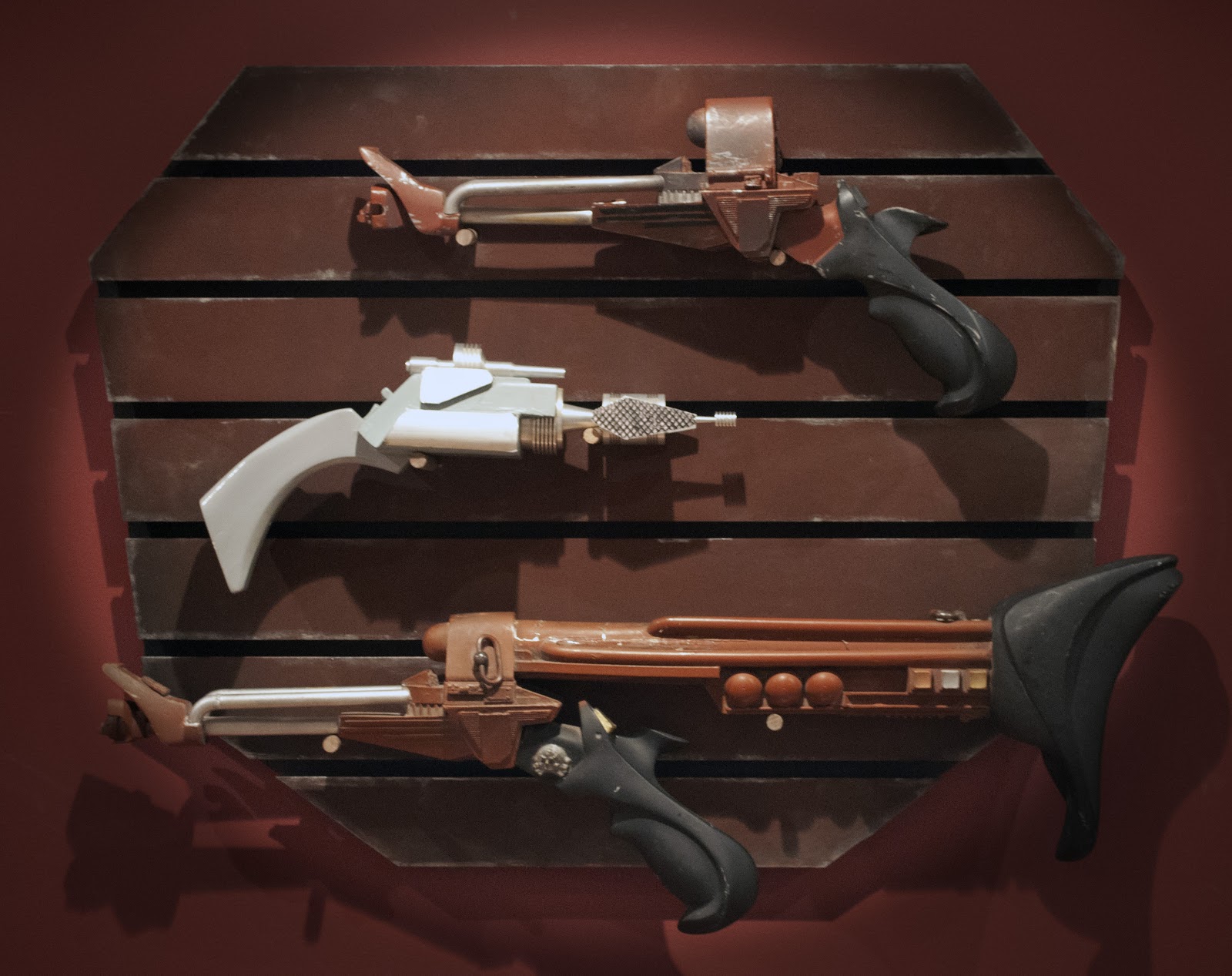
Klingons!! Part 2: Weapons Display

In an effort to get my stuff out of boxes and into the real world, I created this display for my screen-used Klingon weaponry. I made it from an old piece of slatboard which I then painted and weathered to get that "used Klingon" feel. It is directly lit from a ceiling mounted spotlight. I'm thinking about adding some title cards to each piece.


Tuesday, December 4, 2012

The Complete Guide to Starfleet Style OR Everything you ever wanted to know about TOS movie uniforms!

To say that I like the uniforms from the TOS movie era is a bit of an understatement. I don't simply like them – I'm fascinated with them. Absorbed. Beguiled. Enthralled. In short: I dig 'em!

Which is why I've been so focussed on adding a full compliment of those uniforms to my screen-used collection. To that end I've been able to land almost every version of Starfleet uniform as seen in Star Trek II: The Wrath of Khan through Star Trek VI: The Undiscovered Country.


Here's the list:

1. The Class-A Officer's Maroon. This is the pinnacle of Trek uniform for me. I'm fortunate enough to have both male (Spock's!) and female (Rand's) versions.

2. The Officer's Maroon Bomber Jacket. A variant of the standard Maroon, the Bomber was only worn by three characters: Captain Kirk, Scotty and Starfleet Commander Morrow.  My version is a Scotty as seen in Star Trek III and is a very rare piece.

3. The Officer's Vest. Another variant of the standard Maroon, a Vest version was only worn by three characters: Kirk, Scotty and Saavik. Mine is a Saavik from Star Trek III and is made of leather.

4. The Engineering Radiation Suit. Seen throughout the film sires, the distinctive Rad Suit came to represent Scotty's department. The Rad suit is not so much a uniform as it is a protective suit, meant to shield Scotty and his Engineers from any harmful radiation in the ship's warp core. Mine is a variant worn by one of the Starfleet Assassins in Star Trek VI.

5. The Crewman Jumpsuit. Also maroon in color, the Jumpsuit was worn by enlisted personnel throughout the Enterprise.

6. Sickbay Scrubs. First seen in Wrath of Khan, McCoy and his staff wore their distinctive white uniforms while on duty in Sickbay. My version is a standard female nurse.

I did say I had "almost every version" of uniform. The only significant version I'm missing is the maroon suit worn by security personnel. While I hope to land one some day, for now I'll have to settle for being security-less.

In the near future I'll be featuring each style of uniform in individual Blog installments, giving some insight about the design, accessories and history of each. It will be scintillating reading for every fan of Starfleet couture!

LLAP

Don

Star Trek Into Darkness Teaser Poster Released

Say what you will about J.J. Abrams (and I do) he seldom goes in expected directions. Those directions might ultimately make no freakin' sense, but you didn't see it coming, that's for sure. That's again the case with the newest Trek production "Star Trek Into Darkness" and it's newly released teaser poster, seen below.


JJ is notoriously tight with details about his movies and I have no problem with that. The more I know ahead of time, the less I have to discover at the theater so I want to be surprised. And at first glance, the new teaser certainly doesn't give much away while it also is a far cry from Treks past. It shows ominous destruction of a an unnamed city with a dark figure poised at the center seemingly surveying his handiwork, all of which comes together to form a jagged, war-torn Starfleet delta symbol. Nice work, in my opinion. It does what a teaser should do – tease us with questions while giving no answers. What city is it? What planet? Who's the guy? What the heck is going on? Perfect.

Except there's one problem. When the poster is seen on its own, it tells little. But when combined with Paramount's official plot synopsis, I think there's little doubt to Trek fans who the guy is and what the basis of the film is. If you don't know what I'm talking about then you're probably not a fan of the original Star Trek series, the basis for these new films. Based on the synopsis and this poster, there's only one person it CAN be, and it sure ain't Khan. And you know who I'm talkin' about. Here's the synopsis:

“When the crew of the Enterprise is called back home, they find an unstoppable force of terror from within their own organization has detonated the fleet and everything it stands for, leaving our world in a state of crisis."

So the cat is (sort of) out of the bag. I was bound to find out who the antagonist was before I was the film. After all, it won't be out for 6 months and I'm sure that piece of info will be in the mainstream long before opening day. But that's as far as I want to know. I was not a fan of the last movie and I'm not really expecting much from this one. But I want to give it the greatest chance to sway me that I can give, so I'll watch for spoilers and stay away until May.

And then we'll see if trekking Into Darkness is a good thing or not. At least the poster doesn't have any lens flares!

LLAP

Don


ssss

Tuesday, November 27, 2012

Klingons!!! Part 1: Gorkon and his General

 NOTE: My wife broke her leg in October so I've been away for a while. But she's on the mend so I'm back. Thanks for reading.

Klingons are synonymous with Star Trek. They were Trek's original "interstellar badguys" and were first seen in the 1967 original series episode "Errand of Mercy". They didn't look much like the Klingons we've come to know, but their basic qualities were firmly established – they were a warlike race who advanced themselves by conquest, the antithesis to the peaceful Federation. The Klingons were greatly expanded upon and better defined in the movie era, and by Star Trek VI: The Undiscovered Country, we were given our first glimpse of Klingon society. Kirk, Spock and the crew of the Enterprise were thrown into an interstellar conspiracy that held the future of the Federation and Klingon Empire in its grasp. Star Trek VI was the last of the TOS movies and was a finale of sorts – a send-off of the original cast and a turning over of the reigns to The Next Generation. And it's one of my favorites.

Director Nick Meyers wanted to see a different side of the Klingons. Up to then, they were the one-note evil-doers and Meyers was determined to show them as more that just cardboard cutouts. To that end, his story featured the assassination of the Klingon head of state, Chancellor Gorkon and embroiled our Starfleet heroes in the turmoil of intrigue. For the first time, we saw the Klingons as a true race and society, not just a snarling antagonist needed to fill a plot line. Star Trek VI would cast the die for the portrayal of Klingons from then on.

At the center of the story was Chancellor Gorkon and his chief of staff, General Chang, as well as Gorkon's daughter, Azetbur, and several generals who rounded out the Klingon inner circle.

Gorkon, wonderfully played by actor David Warner, was presented as a peacemaker, a Klingon who was actually willing to make true peace with his long-time enemy, the Federation. I don't think that it's accidental that Gorkon has a passing resemblance to Abraham Lincoln. Warner played Gorkon with gravitas and dignity, becoming a true martyr for the cause of peace, not unlike the 16th President. Appropriately, his costume set a new style tone for Klingons. For Gorkon and Azetbur, gone were the all-gray warrior costumes that Klingons had been wearing since the first film. In their place were striking scarlet and gray ensembles – regal-looking garb befitting their high-placed station. Even the generals got a bit of an upgrade – still gray, but with all-new tailoring. Evidently, vinyl is highly prized on the Klingon homeworld, cuz these babies are full of it.

When a Gorkon costume came up for auction several years ago, I was determined to have it. Luckily, I was able to prevail, and my Gorkon is one of the highlights of my collection. I was recently able to add the costume of one of his aides – the one who who crudely stuffed his mouth at the state dinner. Both pieces are in excellent condition and feature internal costuming tags.

The Gorkon can be screen-matched to his death scene and features the "phaser hole" and small remnants of the pink Klingon "blood".

The Gorkon features a beautiful metal belt buckle, quilted details, the definitive horned Klingon boot, and chain-embedded shoulder piece. The costume is super-clean, displays beautifully and stands as a superlative example of the movie-era costume design.


Gorkon's General features quilted details, detailed pants, shoulder and waist chains and Klingon boots. Many of these gray Klingon uniforms were extensively reused over the years in the later Trek incarnations – Next Generation, Deep Space Nine, Voyager and Enterprise – but this one escaped that fate for some reason. It is as clean as the last day of shooting for Star Trek VI and stands as an excellent example of movie Klingon.


I'll be showing more Klingon pieces in the future. Thanks for reading. Qapla' !

LLAP

Don Hillenbrand